Queen's Temple
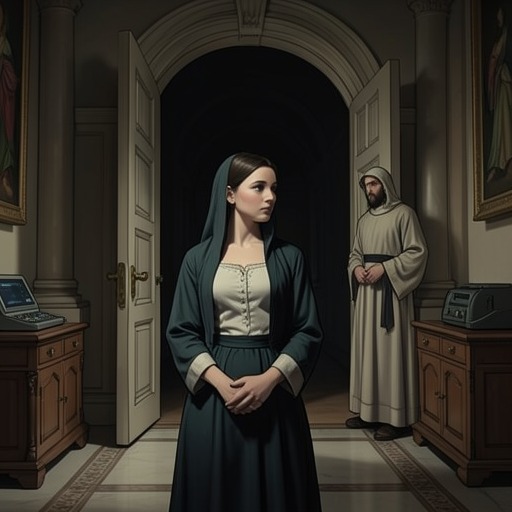
The Vampire Prince’s BrideQueen's Temple is the Demante System's institution for raising the foreign woman destined to become its queen. Cheryl has lived there since infancy, after being purchased from Earth, and the temple has shaped her education, body, expectations, and future reproductive role. Its most decisive function is to prepare a temple-slave for marriage to the champion selected as king, thereby preserving a political order spread across twelve planets and defended by fleets of warrior-slaves.
Institution and Social Function
Queen's Temple exists within a society built by men after the disappearance of its women in the distant past. Because the Temadian people could no longer reproduce without obtaining women from other systems, their old practice of stealing women eventually became a ceremonial institution: each new queen is still a temple-slave acquired through trade with another species. The temple therefore preserves the memory of coercive reproduction even after the original custom has formally died out.
The queen's marriage is inseparable from the Demante succession system. The king is not simply inherited; he is chosen from champions who fight through a series of battles, with the Gods selecting the tournament survivor. Once married to the queen, that victor becomes king. Queen's Temple consequently stands at the junction of religion, monarchy, slavery, warfare, and reproduction, converting an acquired human woman into the vessel through which Temadian political continuity is expected to continue.
Cheryl's Upbringing and Preparation
Cheryl was selected while still a baby and knew from childhood that she was intended to become the next queen of the Temadian people. Her mother served as her principal teacher until her early death, after which Priest Quincy, the head of Queen's Temple, remained responsible for her upbringing and for the ceremonial transition into royal life. The institution is thus presented as both her home and the authority that has claimed ownership of her future.
The temple also alters Cheryl's body for a specific dynastic purpose. Her genes have been modified gradually since childhood so that, once she becomes pregnant by the king, the child will be a pure-blooded Temadian. The process is described as taking a lifetime to replace, making Cheryl indispensable to a system that cannot continue without a king to govern its planets and command their defensive forces. Her personal destiny is therefore treated as a state necessity rather than as an individual choice.
The Coronation Threshold
On the day the previous Demante king dies, Queen's Temple prepares Cheryl to leave. Acolytes paint her lips red, braid her golden hair into a crown, and dress her in a tight black gown before escorting her to Priest Quincy. The preparation makes her body into a visible emblem of queenship, while the strained seams of the gown expose the institution's disciplinary attitude toward her weight and appearance.
Priest Quincy responds to Cheryl with distaste and reminds her that she has failed to lose the weight he demanded. His criticism shows that the temple's guardians regard the future queen as an object to be corrected even at the moment of her elevation. Yet he cannot cancel the role it has assigned her: Cheryl's altered body, long training, and reproductive destiny make her transfer unavoidable. She leaves knowing that her future is supposed to consist of luxury and a lifetime spent giving her king dark-blue children.
The departure is staged as a sacred public spectacle. Quincy leads Cheryl outside, where a crowd chants her name. A stone platform equipped with concealed hover engines carries her above the people and deposits her at the top of the palace steps. The movement from temple to palace marks her separation from the protected institution and her entry into the royal world, but it also reveals that the temple's authority extends outward through ritual, crowd participation, and the machinery of state ceremony.
Tension Between Tradition and Choice
The temple's ceremonial order is destabilized when Cheryl discovers that two men, Bjorn and Maskin, are waiting below rather than a single king. The established model expects one queen and one victorious male champion, but Cheryl ultimately refuses to reproduce the rivalry that the system has placed around her. After both men are healed, she takes their hands and returns with them to her cabin before declaring that, from then on, if one has her, the other must have her as well. She insists that they remain together and threatens to reject both if they fight again.
This decision transforms the temple's inherited arrangement into a chosen triadic partnership. Cheryl remains the queen produced by the institution, but she asserts authority over the terms of her relationships instead of allowing the coronation tradition to dictate a single husband. The cabin, associated with her former temple-centered life, becomes the place where she sets the condition for her future. The institution creates the role; Cheryl determines how that role will be inhabited.
Ritual Space and Concealed Knowledge
Queen's Temple also belongs to a wider network of sacred institutions whose ceremonies regulate identity and communal continuity. Elsewhere, Kenner explains that every twenty-five years all unjoined Kinai men and women older than twenty and younger than thirty spend the winter at the Rookery, where beastlings hatch and the Joining takes place. He describes Joining as the practice that makes the Kinai who they are, while acknowledging that such knowledge is guarded as a secret.
The contrast clarifies the temple's narrative significance. In both settings, a restricted sacred place controls access to a society's central transformation: the temple prepares a foreign woman for queenship and reproduction, while the Rookery gathers eligible Kinai for a rite that defines communal identity. Such spaces separate ordinary life from a charged ceremonial threshold, then return participants to society under a changed status. Queen's Temple is therefore not merely a building but an apparatus through which the Demante System repeatedly converts bodies, marriages, and biological succession into sacred political order.